

Animal Care
Text
Philosophy
Our Animal Care department aims to stimulate curiosity, interest, and a deep respect for the natural world, moving students toward experiencing "real" animal husbandry. The department has a strong belief in developing students into confident, compassionate handlers through the three years of the Animal Care course. Using relevant, real-world examples, we enthuse our students and provide them with the vital skills and knowledge necessary to pursue animal care further - whether that is in their future careers or as responsible pet owners in their everyday lives.
Curriculum design
At the heart of our course is a dedicated team focused on delivering lessons that blend theoretical knowledge with practical, hands-on experience of handling animals. Through a wide variety of interactive learning situations, we encourage students to actively study, practice, and apply animal care principles with confidence.
-
Handling Experience: Students will get the opportunity to handle a variety of animals both in school and at sites outside of school. This will start off with basic handling skills and will build to encompass the theory that has been learnt during the course.
-
Digital Skills: Students will be able to hone their digital skills during the course through both independent and guided work in the lessons. These skills will enable them to complete their Non-Examined Assessment (NEA) to create an individual piece of work that can then be moderated.
-
Extended Learning: Classroom experiences are reinforced beyond the school gates through a mixture of external visits to various animal care centres, as well as using home learning to further their understanding of the content that has been covered.
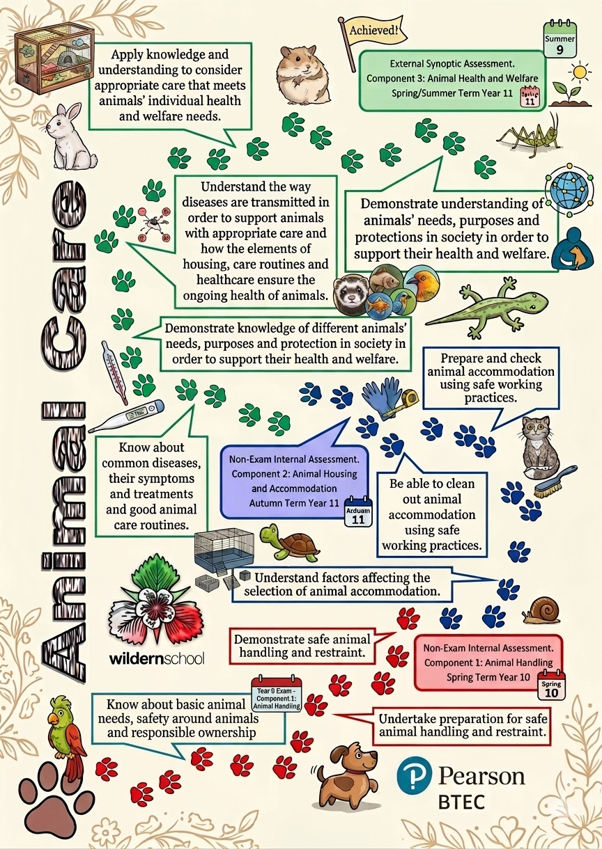
In Key Stage 4 (Years 9, 10, and 11), students complete a comprehensive curriculum managed by Pearson. The course is taught through a combination of practical, hands-on work and content-based theory lessons.
The curriculum is split across three core components:
-
Component 1: Animal Handling
Students will develop the essential, practical skills required to safely, confidently, and respectfully handle and restrain a variety of animals, learning to interpret animal behaviour and ensure low-stress interactions.
-
Component 2: Animal Housing
Students will focus on the preparation, maintenance, and assessment of safe, enriching accommodations for different species, preparing students to meet the exact environmental needs of animals in a professional or domestic setting.
-
Component 3: Animal Health and Welfare
Students will explore the fundamental principles of animal biology, disease prevention, and nutrition, gaining a deep understanding of the legal frameworks and daily practices required to protect and promote excellent animal welfare.
Assessment Framework
The Pearson Animal Care course is assessed through Non-Examined Assessment (NEA), and formal written examinations across. To closely monitor pupil progress and ensure students are building a secure foundation, a core progress exam is administered at the end of Year 9 to evaluate their understanding of the fundamental curriculum content covered so far. In Years 10 and 11, the focus shifts to practical and theoretical coursework; students complete rigorous NEA tasks based around Component 1 (Animal Handling) in Year 10 and Component 2 (Animal Housing) in Year 11. The course culminates at the end of Year 11 with a comprehensive external written examination focusing entirely on Component 3 (Animal Health and Welfare). A student's final GCSE-equivalent grade is holistically determined by their performance across the two NEA components and the final external exam.
Extracurricular opportunities
Throughout the animal care course there are lots of extracurricular opportunities to explore. Alongside the companion animal handling in lessons (guinea pigs and hamsters) we will also be exploring handling of other animals at external providers. Every year we host Living Eggs on-site, giving you the unique opportunity to witness eggs hatching first-hand and take responsibility for the care and wellbeing of the new born chicks. We also spend some time with a falconry team, learning all about different birds of prey and how they are adapted to their environment as well as holding the birds and getting to ask our own questions.