
IT / Computer Science
Text
Welcome to our Key Stage 3 Computing Curriculum!
We are thrilled to share an overview of our updated, future-focused Computing curriculum.
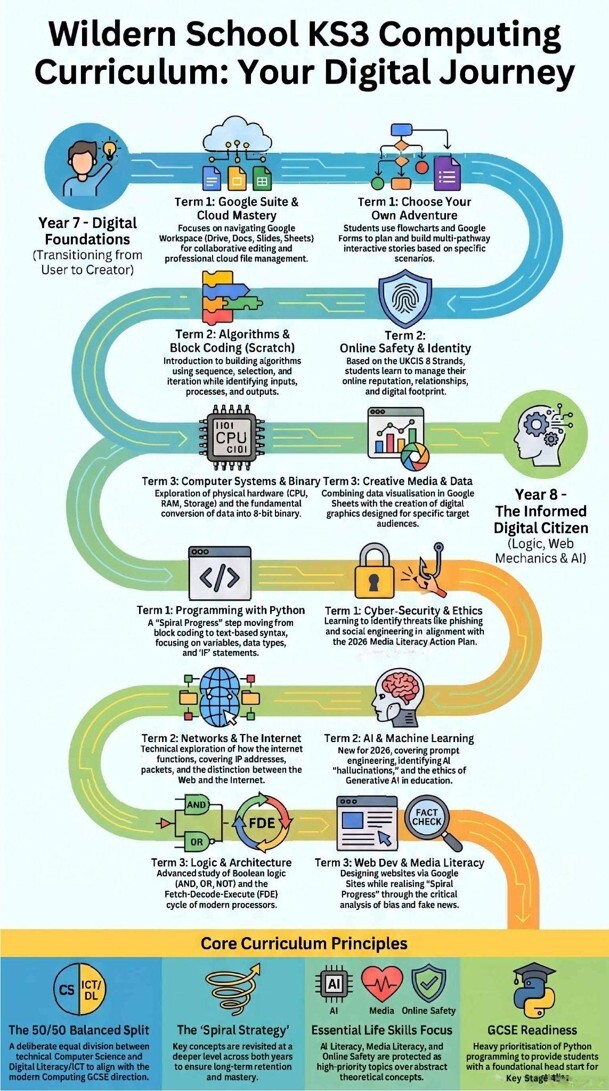
Our curriculum maintains a balanced 50/50 split between technical Computer Science (CS) and Digital Literacy/ICT. This structure ensures our students build both deep technical knowledge and a broad understanding of how digital technology shapes society, perfectly aligning with the modern "Computing GCSE" direction.
Expanders
-
KS3
Year 7: Digital Foundations
In Year 7, our students establish a strong "digital baseline" as they transition from being technology users to creative technology creators. Here is what they will explore across the year:
-
Term 1: Cloud Mastery & Interactive Storytelling – Students learn to navigate Google Workspace, master collaborative editing, and handle professional cloud file management. They also dive into planning and creating multi-pathway "Choose Your Own Adventure" stories using flowcharts and Google Forms.
-
Term 2: Coding Foundations & Online Safety – We introduce algorithms and block-based coding through Scratch, teaching students about sequence, selection, and iteration. Alongside this, students focus on crucial online safety frameworks, learning how to responsibly manage their online reputation and relationships.
-
Term 3: Inside the Computer & Creative Media – Students uncover how internal hardware like the CPU and RAM work, alongside basic 8-bit binary conversion. They also learn to use Google Sheets for basic data visualisation and create digital graphics tailored to a specific target audience.
Year 8: The Informed Digital Citizen
In Year 8, the focus shifts towards text-based logic, understanding the inner mechanics of the modern web, and confidently navigating the world of Artificial Intelligence.
-
Term 1: Python Programming & Cybersecurity – Students take a exciting step forward by moving from Scratch to text-based Python syntax, focusing on variables, data types, and "if" statements. They also study vital cybersecurity themes like phishing, social engineering, and modern system protection.
-
Term 2: Networks & AI Literacy – Students explore the mechanics of how the internet works, covering IP addresses, packets, and the difference between the World Wide Web and the Internet. They also tackle cutting-edge topics in AI, learning about prompt engineering, spotting AI "hallucinations," and discussing the ethics of Generative AI.
-
Term 3: Advanced Logic & Web Development – Students dive into Boolean logic and the Fetch-Decode-Execute cycle of modern processors. They wrap up the year by designing websites using Google Sites, whilst critically analysing online information for bias and fake news.
Our Learning Approach: Built for Success
To give our students the best possible preparation for the future, our curriculum relies on a few key guiding principles:
-
The Spiral Strategy: We design our curriculum so that if a student misses a concept in Year 7, they encounter it again at a deeper level in Year 8.
-
Prioritising Essential Life Skills: We firmly protect vital areas like AI literacy, media literacy, and online safety over abstract theory. We ensure students understand that Generative AI is a tool requiring human oversight and cannot replace their own subject knowledge.
-
GCSE Readiness: Foundational skills like Python programming are heavily prioritised to give students a brilliant head start should they choose to pursue Computing at GCSE level.
-
-
KS4
Year 9: Digital Pathways
Digital Pathways is a foundation course designed to prepare students for their Key Stage 4 qualification. Over the course of Year 9, students experience a balanced combination of academic computer science and vocational information technology. This structure provides the necessary skills and diagnostic data to guide students into the correct pathway for Years 10 and 11.
Course Structure
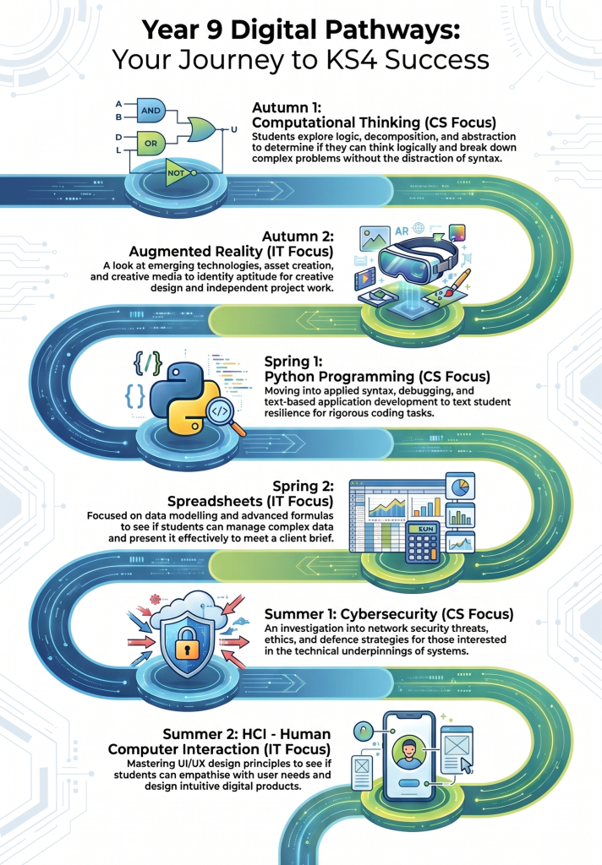
The curriculum is divided into six half-termly units that alternate between Computer Science (CS) and Information Technology (IT) disciplines:
Unit
Focus
Core Skills & Concepts
Computational Thinking
Computer Science
Problem-solving, logic, decomposition, and abstraction.
Augmented Reality
Information Technology
Creative media, asset creation, and emerging technologies.
Python Programming
Computer Science
Text-based coding, applied syntax, and program debugging.
Spreadsheets
Information Technology
Data modelling, advanced formulas, and presenting data for a client brief.
Cybersecurity
Computer Science
Network security threats, digital ethics, and defence strategies.
Human-Computer Interaction
Information Technology
User Interface (UI) and User Experience (UX) design principles.
Key Stage 4 Progression
At the end of Year 9, student performance and aptitude across these six units will determine their placement into one of two distinct examination pathways for Years 10 and 11:
-
GCSE Computer Science: An academic, theory-driven pathway focusing on abstract logic, system architecture, and advanced text-based programming.
-
OCR Cambridge National in IT: A vocational, project-based qualification focusing on real-world digital applications, asset design, and independent project management.
Year 10 & 11
KS4 Computer Science - GCSE Computer Science
This is a single-tier, linear GCSE in Computing Science and is a potential pathway for students studying Digital Pathways. By delivering a GCSE in Computing Science we will be providing more choice to students who wish to study for a recognised qualification in computer science. Whilst recognising that computing science is a rigorous academic subject, we hope that this new GCSE will foster creativity and inventiveness. The new specification 'Computing Science' will emphasise the fact that learners will be expected to apply their knowledge of computer systems and programming to solve problems using rapid prototyping techniques to test out ideas and prove that they work.
Learners are expected to:
-
AO1: Recall, select and communicate their knowledge and understanding of the concepts and principles of computing science.
-
AO2: Apply tools and techniques from computing science to analyse problems and produce solutions.
-
AO3: Understand, evaluate, make reasoned judgements about the use of computer systems in industry, commerce, arts and elsewhere, including ethical, social, legal and environmental factors.
GCSE Computing Science will have 2 Assessment components: One externally assessed 1 hour 30 minute examination paper, contributing 50% of the total assessment weighting. One externally assessed, 2 hour on-screen practical programming exam, contributing 50% of the total assessment weighting.
The GCSE Computing Science qualification will be available to all learners who are capable of reaching the required standard. It will support progress to further study at Level 3, including GCEs and BTECs in IT, Computing and related subjects.
KS4 ICT - OCR National in IT
Students will learn theoretical knowledge and understanding to apply design tools for applications, principles of human computer interfaces and the use of data and testing in different contexts when creating solutions or products.
Students will understand the uses of Internet of Everything and its application in everyday life, cyber-security and legislations related to the use of IT systems, and the different types of digital communications software, devices and distribution channels.
Students will learn the skills to be able to plan and design a spreadsheet solution to meet client requirements. They will be able to use a range of tools and techniques to create a spreadsheet solution based on their design, which they will test.
Students will learn the purpose, use and types of augmented reality (AR) in different contexts and how they are used on different digital devices. They will develop the skills to be able to design and create an AR model prototype, using a range of tools and techniques.
Students will also be provided with the opportunity to develop transferable skills such as researching, planning, reviewing, working with others and communication.
Students will study 3 units over the duration of the course. This consists of two controlled assessment units worth 30% each and one written exam based unit, which makes up the remaining 40%
The controlled assessment units consist of:
R060 - Data Manipulation using Spreadsheets
R070 - Using Augmented Reality to Present InformationThe exam based unit is:
R050 - IT in the Digital World -
Co-Curricular
A coding club is available to any students that are keen to learn and develop their coding skills. The main language learnt is Python but others can be explored. Drop in clinics run daily during lunch and after school to support pupils learning.
Trips
A unique trip to visit Bletchley Park, the home of British codebreaking and a birthplace of modern Information Technology. Students will spend the day learning about how Alan Turing, the Founder of Computer Science, cracked the Enigma code that helped the allies win WWII. The guided tour and workshop included explore mathematical encryption and encoding techniques that have been used throughout history, tackling complex processes to solve a code breaking challenge. The workshop also includes a unique opportunity to see a genuine Enigma machine and be introduced to its design and role in WWII.