
Pathways
Text
In Year 8 we ask students to make choices about the subjects they would like to study through to the end of Year 11.
Throughout the year they will take part in a planned programme to help them to make the right decision which includes:
-
Information assemblies
-
Pathways booklets with information about each subject
-
Taster lessons (all students will have a taster lesson for all pathways subjects. These are delivered within their current timeline
-
Tutor Slides: How to complete your pathways form
-
Year 8 Speed networking events linked to our careers programme
Useful Links
-
Pathways FAQ Click Here
-
Completing your pathways form using SIMS (Setting up your login details support guide)
- Support from their tutor through our Education for Life programme
Key reminders on completing your Pathways Form
Parent Information Slides
● Please see the attached files at the bottom of this page
Pathways: Key Dates 2027
|
Thursday 21st January |
Pathways Information Assembly |
|
Thursday 21st January |
Parent Information Evening |
|
Thursday 21st January |
Pathways Information Assembly |
|
Weeks beginning Monday 1st February and Monday 8th February |
Communications Lesson to complete SIMs login detail EL pathways Lesson |
|
Thursday 28th January |
Year 8 Parents Evening |
|
Thursday 4th February |
Year 8 Careers event |
|
HALF TERM |
|
|
Week beginning Monday 22nd February |
Pathways subject information assemblies and quizzes in tutor Pathways booklets sent home |
|
Weeks beginning Monday 22nd February and Monday 1st March |
Pathways tutor sessions including Transition Leader visits to tutor time to answer any questions you may have |
|
Week beginning Monday 8th March |
Pathways Tutor sessions, including how to complete your pathways forms guidance |
|
Monday 1st March - Friday 12th March |
Subject Taster Lessons (These are built in to your timetabled lessons) |
|
Friday 12th March |
Pathways forms emailed home |
|
Monday 22nd March |
Deadline for Pathways forms |
COMPLETING YOUR PATHWAYS FORM USING ARBOR
Video
Expanders
-
Making the right choice
This is an exciting but very important new chapter in your child’s school life. It is important to consider these choices carefully so that your child is in a good position to make an informed decision.
It is important for your child to consider:
-
Their interests and areas of strength
-
What each subject involves, including examination and non-examination assessment requirements (coursework)
-
Future career paths or what they might like to study at College
-
-
Advice for students
-
Choose a subject you enjoy and are good at.
-
Don’t choose a subject because your friends are doing it or because you like a particular teacher. Most probably your friends will be in a different class and you will have a change of teacher.
-
Do not select a subject thinking that you can change your mind later.
-
Talk to your subject teachers, form tutor, parents, or students who already study the subject.
-
Think carefully about what you are going to do when you are 16. Find out what subjects you will need to do the courses you might be interested in taking at college or university.
As a school, we have always acknowledged the importance of studying a language and believe that gaining a GCSE qualification in a language is an important part of a rounded education.
We encourage students to take a GCSE in an MFL subject to prepare them to become global citizens who are curious and knowledgeable of the world that surrounds them.
Language learning promotes resilience, independence and an ability to problem solve; all skills that are widely recognised and sought after by top colleges and universities. A GCSE in a language is attractive to future employers and enables students to understand their own language with more depth and to explore other cultures and people.
-
Text
Pathways subjects
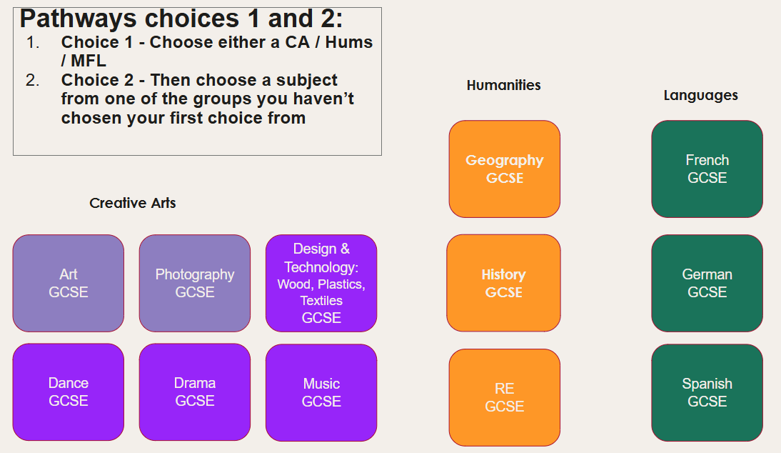
Within the core curriculum, all students will study English, Mathematics, Science, Core PE, EfL and 3 other subjects. They will make two choices from the group below, but only one from each group.
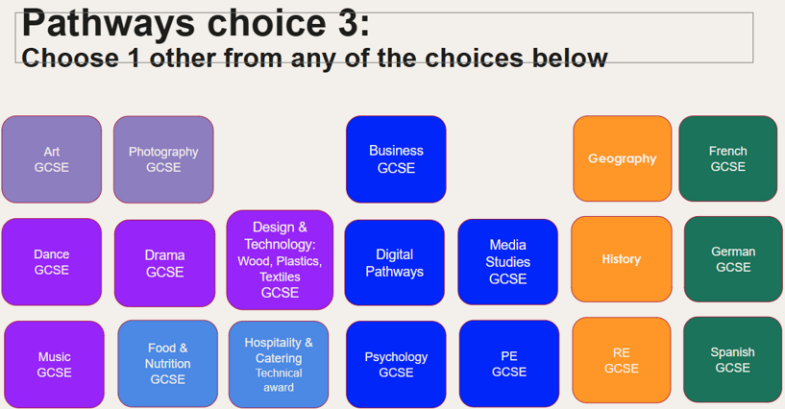
Students will select one further choice from the list below. All students must select a reserve choice and places cannot be guaranteed.