
Religious Education
Text
“The beauty of the world lies in the diversity of its people”
Foster passion and curiosity into the World of Religion whilst providing answers to life's biggest and most important questions whilst promoting respect and empathy in a multicultural society.
Philosophy
The aim of RE at Wildern School is to create open-minded, thoughtful learners who can appreciate different perspectives and navigate the complexities of the modern world with compassion and understanding. We invite deep reflection, critical thinking and meaningful dialogue.
RE Curriculum Design
In RE at Wildern School we explore different religions by looking into key concepts of major religions such as beliefs, practices and experiences. We then contextualise these concepts within religions and evaluate. We support students to come to reasoned responses when developing arguments that shape their views on issues and topics studied. Intrinsic to teaching and learning in RE is to enable students to see that the world and the people within it have many differing views and practices; it is our role to allow pupils to inquire into these ideas and facilitate their learning.
In RE at Wildern we follow the Living Difference agreed syllabus and explore different religions, enquiring into key concepts, beliefs and practices within religions and evaluate their value for society and themselves. The programmes of study are progressively developed to build upon student’s capacities to interpret, evaluate and respond to differing values and beliefs. This is achieved through extending their thinking and analytical skills and their creative, imaginative and emotional development.
In the RE department we strive to achieve the highest standards with our students and create a stimulating environment. We do this by continuously reviewing our schemes of work and resources in order to keep them relevant.
At the centre of our programmes of study is the idea that RE should be a subject that allows students to question and explore, to appreciate that RE is not an abstract subject that doesn’t apply to them but a subject that is intrinsic to the society we live in.
Expanders
-
KS3
KS3 is a two year key stage at Wildern; during these two years students study Judaism, Christianity, Islam, Hinduism in depth but also enquire into philosophical questions through units such as 'Does God Exist?
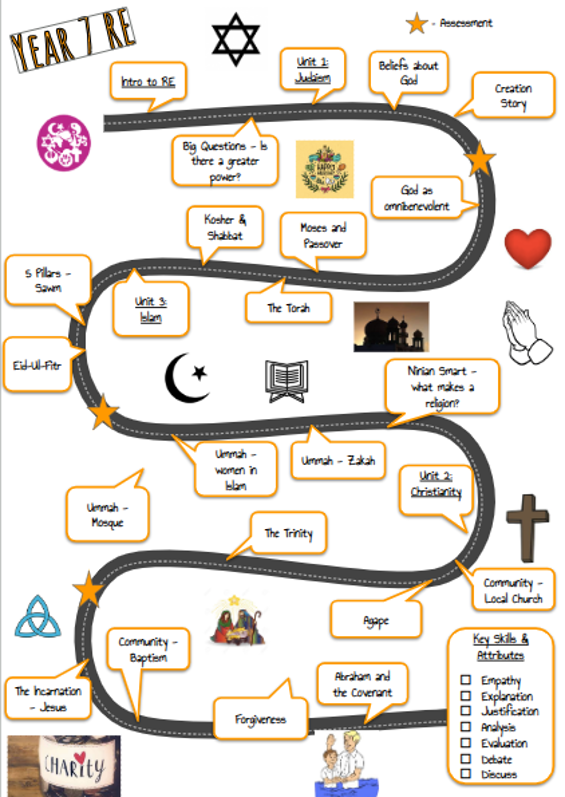
Year 7
Judaism - This unit explores some of the key concepts within Judaism including God, Abraham, Moses and what it means to be a Jew today.
Christianity - This unit explores some of the key concepts within Christianity including God, Jesus, Agape and what it means to be a Christian today.
Ninian Smart - This unit explores Smarts 7 dimensions of a religion with a focus on Islam. Students will explore each dimension through some of the key concepts in Islam.
In year 7 we learn about Judaism, Christianity and Islam. Judaism - this is a three concept cycle that lasts the first term and introduces students to some of the main beliefs and practices within Judaism, we look to make links with the local Jewish congregations in Southampton where possible. The concepts explored in depth are God, Covenant and Torah. We also take a look at Hanukkah and other Jewish festivals. Christianity - this is a three concept cycle and lasts the second term. It introduces students to some of the main beliefs and practices within Christianity. The concepts explored in depth are the trinity, agape and the community. Islam - this is a three concept cycle that lasts the final term. It introduces students to some of the main beliefs and practices within Islam. The concepts explored in depth are Sawm, Ummah and Ninian Smart.
Year 8
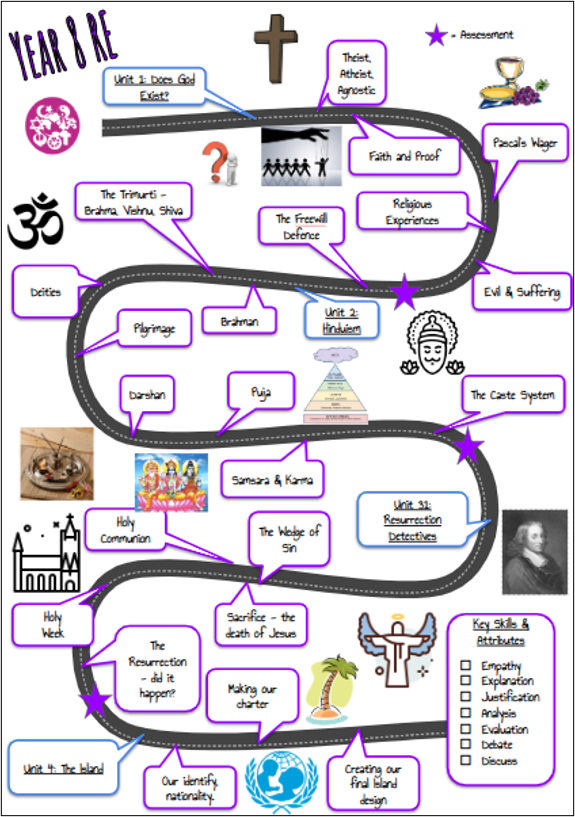
Resurrection Detectives – This unit follows on from the year 7 Christianity scheme and allows students the opportunity to explore the importance of the death and resurrection of Jesus for Christians and debate whether the resurrection did take place
Does God Exist? – This is a philosophical unit, where students get to question key arguments about the existence of God.
Judaism- This unit focuses on the key practices and teachings of the Abrahamic tradition, and investigates the concepts that underpin the religion.
The Smart Guide to Religion- In this unit pupils explore the 7 dimensions of religion with a focus on Islam in preparation for the GCSE.
In Year 8 we look at three units Hinduism, Resurrection Detectives and Does Good Exist as well as The Island, where we explore through UNICEF Rights Respecting designing our own Island. Within Hinduism this is a three concept cycle that lasts the first term. It introduces students to some of the main beliefs and practices within Hinduism. The concepts explored in depth are Brahman, Samsara and Worship. Resurrection Detectives takes place in the second term. It layers upon the year 7 Christianity scheme and allows students the opportunity to explore the importance of the death and resurrection of Jesus for Christians and debate whether the resurrection did take place. Our philosophical unit Does God Exist? Offers students the chance to get to question key arguments about the existence of God.
-
KS4
A GCSE in Religious Education is highly valued by employees due to the nature of transferable skills that it develops. These include, analysis, evaluation, empathy, interpretation, reflection and justification to name a few. It allows students the opportunity to delve into the world that we live in, exploring religious and non-religious views on several themes as well as fostering an ethos of respect for others, an opportunity to challenge stereotypes and build an understanding of other cultures and beliefs. Religious Education provides a space for students to reflect on their own ideas and develop their thoughts about questions of meaning and ethics.
The GCSE is broken down into two exams:
Part One: The study of TWO religions with a focus on Beliefs, Teachings
and Practices (worth 50% of the qualification)
Students will study Christianity and Islam in depth focusing on the key beliefs, teachings and practices of each religion and the influence that this has on individuals, communities and societies.
Part Two: Thematic Studies: An exploration of religious, ethical and philosophical themes (worth 50% of the qualification)
Students will study FOUR themes considering different beliefs and attitudes to religious and non-religious issues in contemporary British society:
- Religion and life – the origin and value of the universe and human life including scientific and religious views on these and the relationship between them. The use of the environment and animals and ethical arguments relating to abortion, euthanasia and life after death
- Religion, peace and conflict – including the key concepts of war, peace, justice and reconciliation. An exploration into the reasons for war, a just war, terrorism, pacifism and responses to war in the 21st century
- Religion, crime and punishment – the causes of crime and different aims of punishment including ethical arguments on the death penalty
- Relationships, family and religion : including the concepts of the family, chasity, marriage, sexuality, polygamy and divorce
The GCSE RE follows the AQA GCSE with an in depth study of two religions and then four themes to complement this.
Religions
- Christianity - beliefs and practices
- Islam - beliefs and practices
Themes
- Religion, Peace & Conflict
- Religion, Crime & Punishment
- Religion & Life
- Religion, Relationships & Family
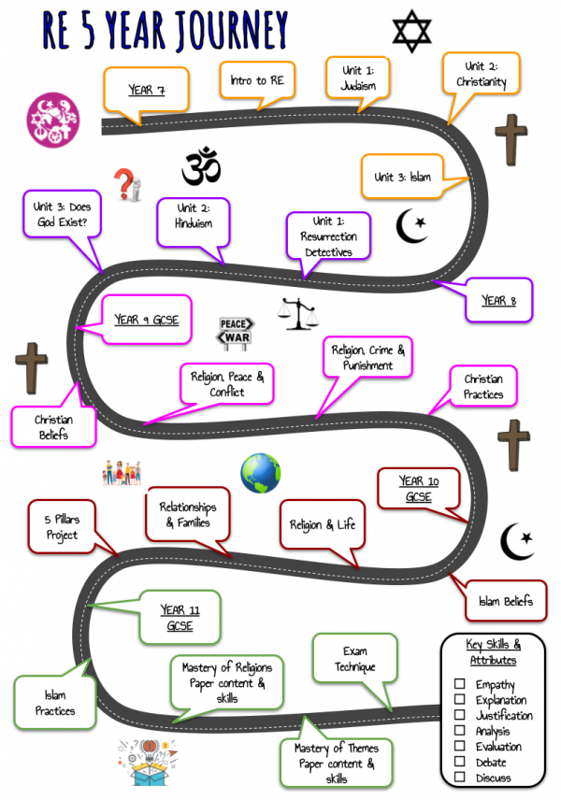
Year 9
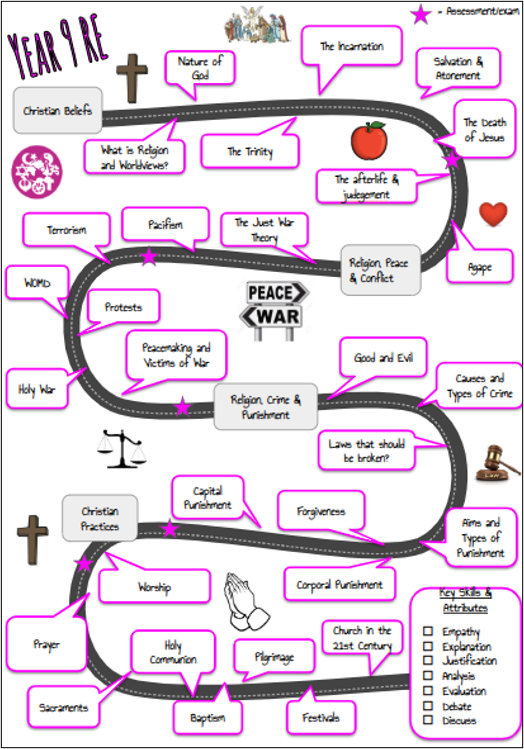
In Year 9, students transition into their GCSE studies by exploring the foundational religious tradition of the UK, before diving into major global and ethical issues. We begin the GCSE course looking at Christian Beliefs, exploring the nature of God, creation, the afterlife, Jesus Christ, and the problem of evil. Religion, Peace and Conflict in the first theme we will look at examining the concepts of war, pacifism, just war theory, weapons of mass destruction, and the role of religion in peace-building. We move on to our second theme Religion, Crime and Punishment where we investigate why people commit crimes, types of punishment, the ethics of the death penalty, and the power of forgiveness. We finish year 9 looking at Christian Practices and how faith comes alive through worship, sacraments, pilgrimage, and the role of the church in the local and global community.
Year 10
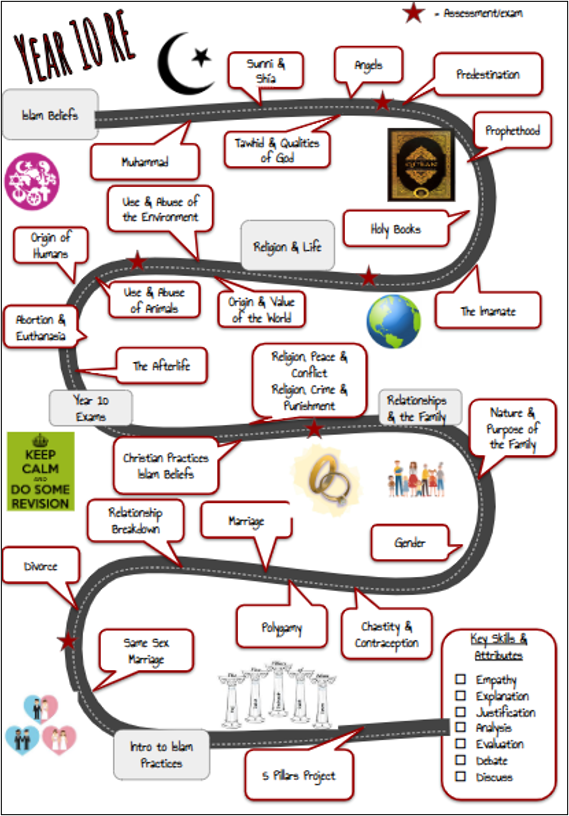
Year 10 broadens our students' horizons by introducing our second core religion, Islam, alongside themes that directly impact daily life and human relationships. We kick start Year 10 looking at Islam Beliefs by delving into the core tenets of Islam, including the Six Articles of Faith in Sunni Islam, the Five Roots of Usul ad-Din in Shi'a Islam, and the nature of Allah. We come away from Islam to look at the theme Religion and Life, tackling massive questions regarding the origins and value of the universe and human life, environmental ethics, abortion, and euthanasia. Following on from this we look at our final theme Relationships and the Family, discussing contemporary and traditional views on marriage, divorce, contraception, gender equality, and the changing nature of family structures. We finish year 10 beginning to look at Islam Practices where students conclude Year 10 by beginning their study into how Muslims express their faith daily.
Year 11
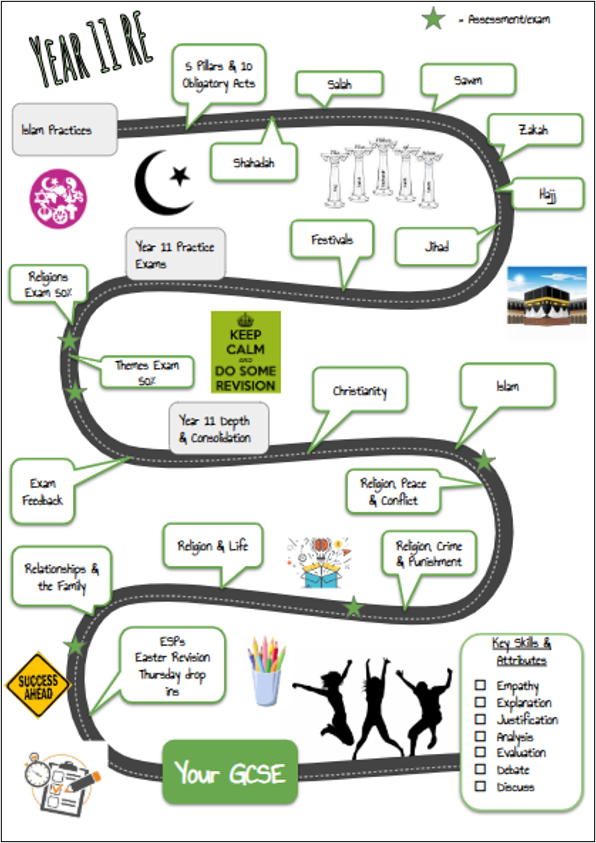
In year 11 we pick up where we finished year 10 looking at Islam Practices by finalising our study of the Five Pillars of Islam, Ten Obligatory Acts, Jihad, and festivals like Eid. We look here to arrange a visit to the Abu Bakr Mosque with our year 11 Religious Education students. Part of this first term includes Practice Exam Preparation. A targeted focus on exam stamina, time management, and mastering the 2, 4, 5, and 12-mark question structures ahead of the formal trial exams. Following the practice exams we add depth to our course by revisiting key themes and our two religions so that students are able to make synoptic links between themes and religions in depth. The final year is dedicated to consolidation, rigorous exam preparation, and deepening critical thinking to ensure every student achieves their full potential. The RE department is committed to maximising opportunities for students to reach their full potential by offering revision sessions additional to their lessons.
Text
Extracurricular
Once a fortnight the department runs a Philosophy club that is open to all year groups and builds upon the principles of Philosophy for Children (P4C) This allows students an opportunity to explore and discuss the big questions in life such as ‘is it ever right to break the law’ and ‘is power always a good thing’ The session is facilitated by members of the team and the students have an opportunity to chose the stimulus and questions that they would like to discuss themselves.
In addition to this Wildern takes part in the annual Hampshire Philosothon which gives students a chance to put their skills of P4C into practice and compete against other schools.