

Maths
Text
Philosophy
The Maths Department is committed to creating a culture of mathematical curiosity, resilience, and academic excellence, ensuring every student, regardless of their starting point, can succeed in mathematics. Our aim is for all students to leave Wildern as confident, numerate individuals, equipped to use their mathematical skills in everyday life and the workplace. Our curriculum is designed to inspire and challenge, providing varied strategies and approaches to support all learners and develop problem-solving and critical thinking.
Our intent
-
To provide a rich and engaging curriculum that builds on KS2 learning and prepares students for success beyond KS4
-
To provide a broad and balanced curriculum that is accessible to all learners
-
To develop an understanding of mathematical concepts and principles at a level appropriate to each student’s intrinsic ability
-
To enable students to apply mathematics confidently and effectively in all contexts
-
To ensure skills and processes in Mathematics are transferable across other subjects
Our implementation
We deliver a carefully sequenced, 5-year cumulative curriculum that prioritises mastery techniques and standardised methods, ensuring a seamless and progressive transition between Key Stages from KS2 to KS3 and then on to KS4. The curriculum is designed for the needs of our students, and focus is on re-teach/retrieval and tackling misconceptions to support the best progress for all students.
Each lesson is one component of a broader topic- a part of a sequence of lessons or learning experiences, which will build mathematical understanding and problem-solving capacity, improve fluency and develop mathematical reasoning skills so students can develop a wide range of skills and prepare for the real world, giving maths context.
We prioritise core numerical, geometric, and algebraic fluency, ensuring all students can confidently recall, manipulate, and apply fundamental mathematical principles before moving on to other concepts. Curriculum design with the focus of the needs of our students, focus on re-teach/retrieval and tackling misconceptions.
Our lessons have opportunities for assessment and feedback using a range of AfL strategies. They are relevant and specific for the needs of the class, using adaptive teaching techniques throughout all lessons.
We have a sharp, data driven focus on progress for all students to adapt learning to support and stretch students to maximise outcomes for our students through detailed question level analysis, exit tickets and sing regular, low-stakes diagnostic assessments to identify learning gaps quickly and planning opportunities to revisit and reteach topics.
We hold unwavering high expectations for all learners through our expectations and culture of learning from mistakes, alongside adaptive teaching strategies to effectively support and accelerate the progress of all our students and to foster positive attitudes to learning while raising aspirations for all students.
We explicitly instruct students in mathematical vocabulary and structured communication, enabling them to decode complex word problems accurately and articulate their reasoning.
Expanders
-
KS3
Years 7 & 8
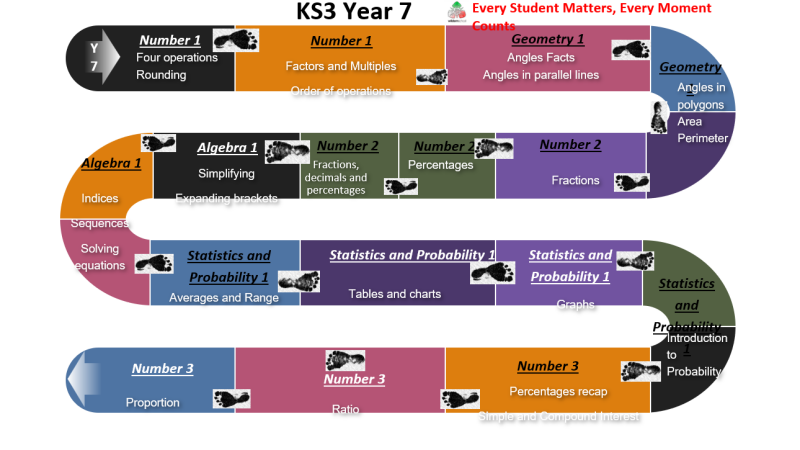
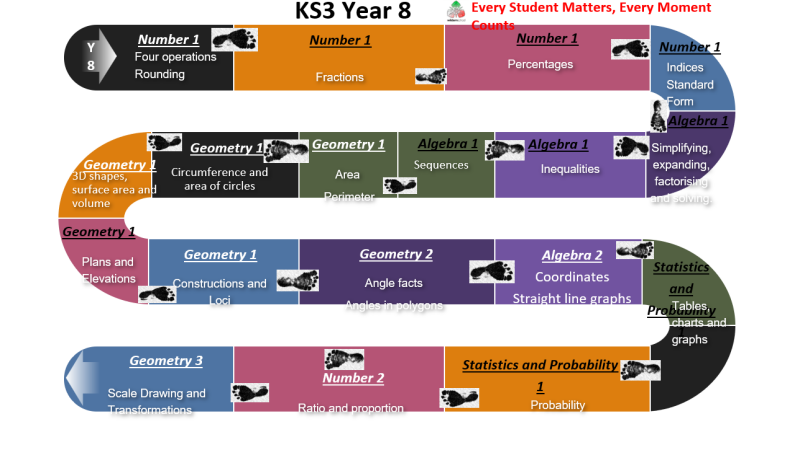
In Years 7 and 8, students embark on an ambitious, two-year Key Stage 3 programme of study that fully encompasses and extends beyond the National Curriculum framework. Actively serving as the foundation of our 5-year cumulative curriculum, KS3 prioritises the transition from KS2 to prepare for the rigor of KS4.
Our curriculum is designed to cultivate deep conceptual mastery, mathematical fluency, and develop reasoning and problem solving skills. Students regularly engage in rich tasks where mathematical investigation skills and analytical reasoning are developed. To support independent learning and prepare students for the modern world, we expect students to practice and use scientific calculators.
Out-of-class study is driven by Sparx Maths, a data-driven platform tailored to individual student needs. We cultivate a culture of independent learning, students are expected not only to complete their compulsory weekly homework but to proactively use the platform's independent learning pathways to close personal knowledge gaps, review challenging topics, and take ownership of their academic success.
-
KS4
Years 9, 10 & 11
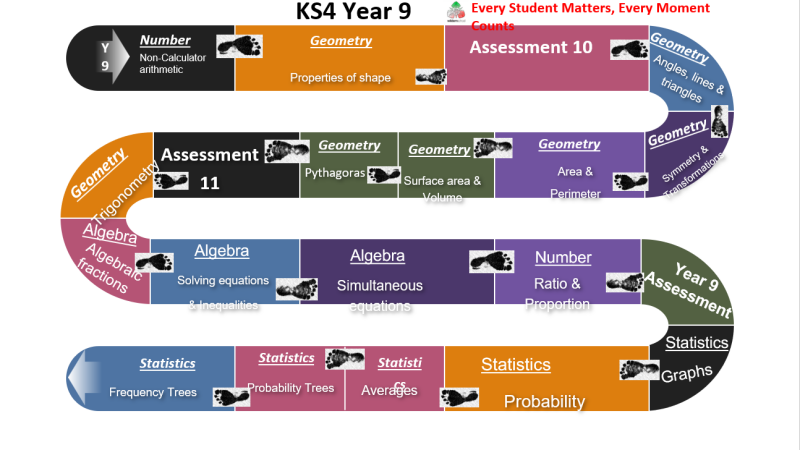
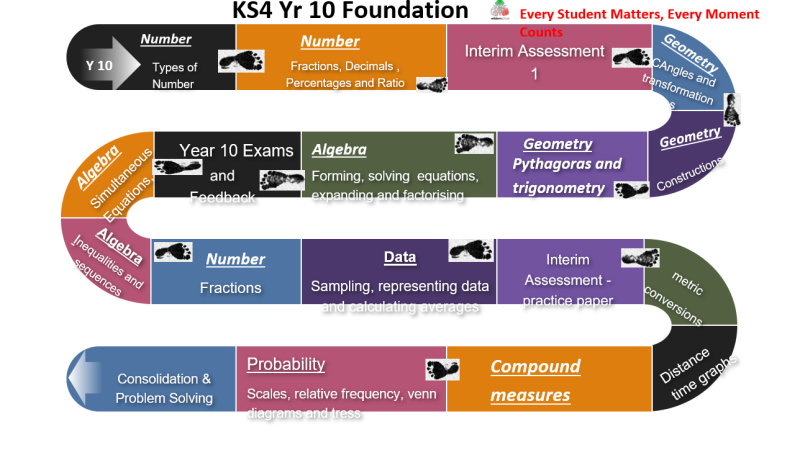
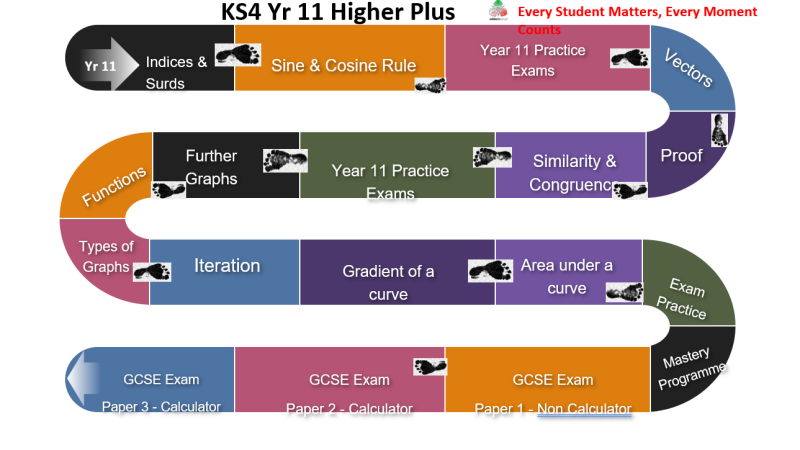
Our Key Stage 4 journey begins in Year 9, providing an ambitious three-year pathway fully aligned with the Edexcel (1MA1) GCSE Mathematics specification. Our most able students also study Pearson Edexcel GCSE Statistics (2017) and are examined in year 10. Our primary objective throughout this key stage is for our students to make maximum progress, ensuring that our students strive for the grade 5 while also stretching higher attainers to achieve top grades (7–9).
The KS4 curriculum is meticulously structured to revisit, consolidate, and significantly extend learning from Key Stage 3 across five core mathematical disciplines:
-
Number (Numerical fluency and financial mathematics)
-
Algebra (Analytical modelling and abstract reasoning)
-
Geometry & Measures (Spatial reasoning and dimensional analysis)
-
Ratio, Proportion & Rates of Change (Proportional reasoning and real-world application)
-
Probability & Statistics (Data literacy and risk analysis)
In alignment with our departmental vision, students are systematically exposed to sophisticated problem-solving tasks and practical applications.
Out-of-class study is driven by Sparx Maths, a data-driven platform tailored to individual student needs, until year 11 where past papers are set weekly. We cultivate a culture of independent learning; students are expected not only to complete their compulsory weekly homework but to proactively use the platform's independent learning pathways to close personal knowledge gaps, review challenging topics, and take ownership of their academic success.
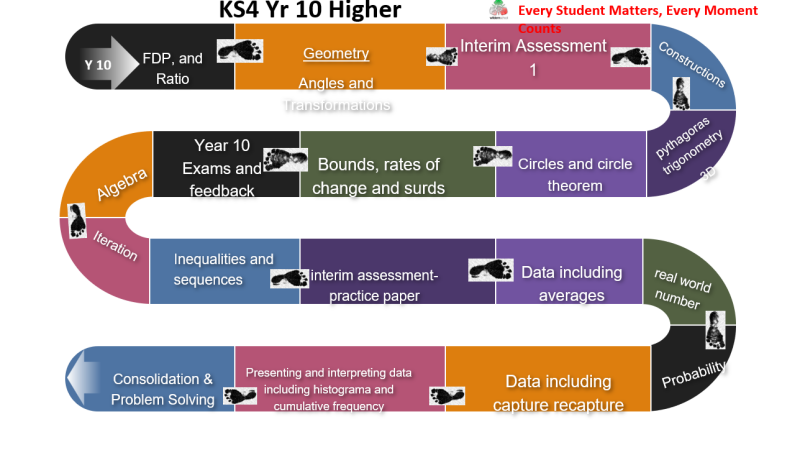
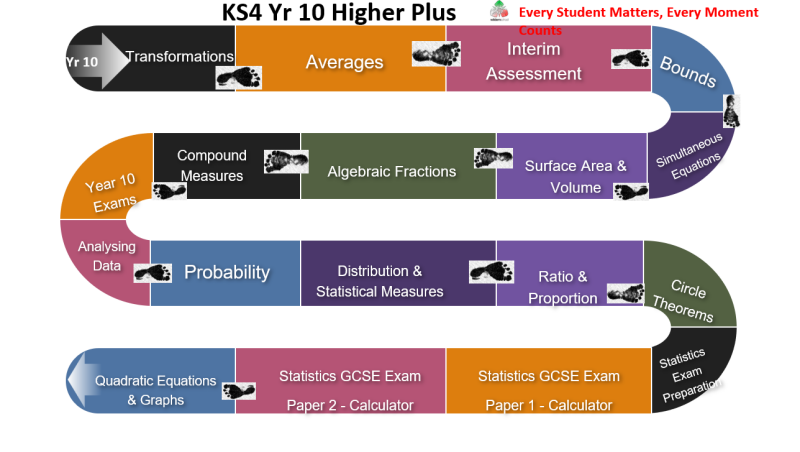
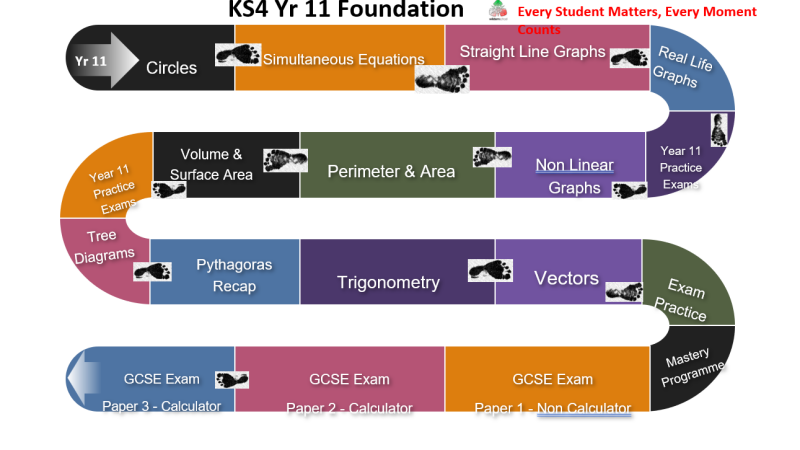
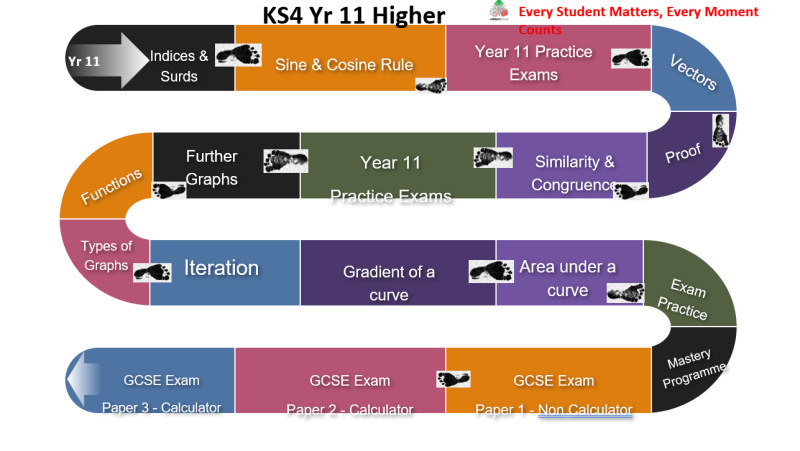
-
Text
Co-Curricular and Trips
Our students enjoy a variety of opportunities to engage in mathematics outside the classroom.
KS3 students can use and develop their strategic thinking through joining the Chess Club which runs on Monday and Friday lunchtimes in room 302.
We run an after-school Drop in self-study clinic on Tuesdays 3pm-4pm in room 301 where one of our Maths Core Progress Assistants is available to help with any mathematics homework. On Wednesday afternoons we have “Logic Club” from 3pm-4pm in room 312
In years 7 and 8 we offer entry into the UKMT Junior Maths Challenge for the most-able students in each year group. We also offer entry to the University of Southampton Maths Challenge to students in years 7-10 where we have enjoyed some pleasing success in recent years.
Watch this space for upcoming visits in Maths.