
History
Text
"A people without the knowledge of their past history, origin and culture is like a tree without roots" - Marcus Garvey
Philosophy
The primary aim of the History Department at Wildern is to educate students in the skills and knowledge they require to be active and reflective members of society by understanding key events of the past and how these continue to shape and influence the world around them. All our students therefore acquire the historical knowledge and skills that help them develop as informed, engaged, and thoughtful citizens.
Expanders
-
KS3
Key Stage 3
To achieve these aims the department will teach a range of time periods and diverse cultures and people. We strive to include narratives of underrepresented communities and bring stories to life to our students through exploring local history. Both of these are carefully woven throughout our curriculum. The elements of Causation, Source Analysis, Interpretation, Significance and Change remain vital for students to understand and so they provide the foundation for KS3 lessons. Whilst the National Curriculum forms the main framework of history studied in KS3 it is supplemented with in-depth studies and enquiries, which allow students to develop a curiosity and love of the subject. The department aims to allow students to delve into the meaty aspects of history and analyse it from a top down as well as at a grass roots level. The department takes seriously the responsibility to teach significant events such as Slavery and the Holocaust, developing social, cultural, moral and spiritual elements and making topics relevant to students today.
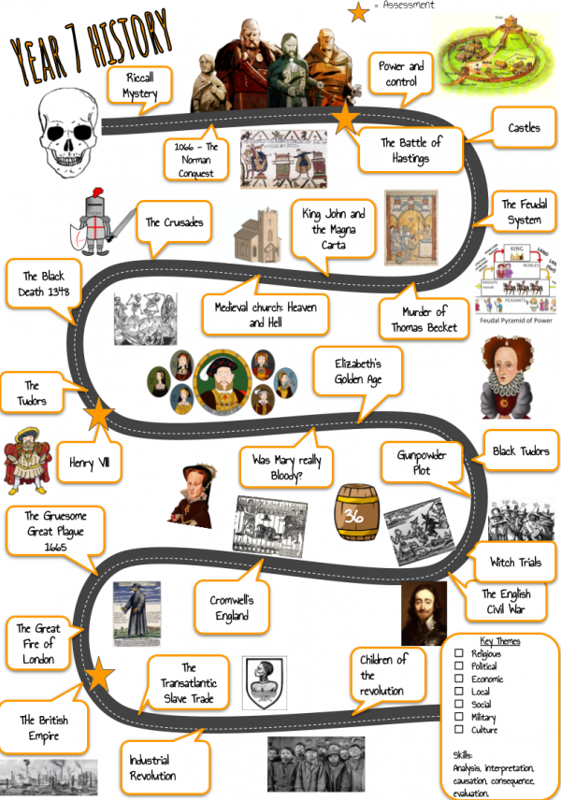
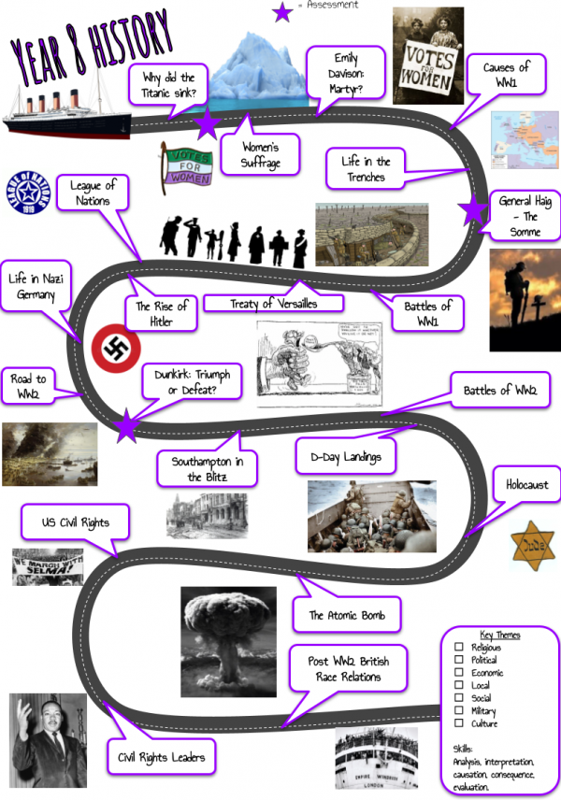
Key topics include:
Year 7
-
The Medieval World; The Norman Conquest, The Medieval Church, The Black Death
-
Early Modern Britain; The Tudors and Stuarts, (Including The Reformation, The Great Plague, The Great Fire of London, The Gun Powder Plot, The English Civil War)
-
The Industrial Revolution, The Slave Trade
Year 8
-
The Early 20th Century; The Titanic, The Suffragettes, Causes and Events of WW1, The Interwar years
-
The Late 20th Century; The Rise of Hitler, Causes of and Events of WW2, (Including the Holocaust, The Atomic Bomb) and Civil Rights.
-
-
KS4
KS4
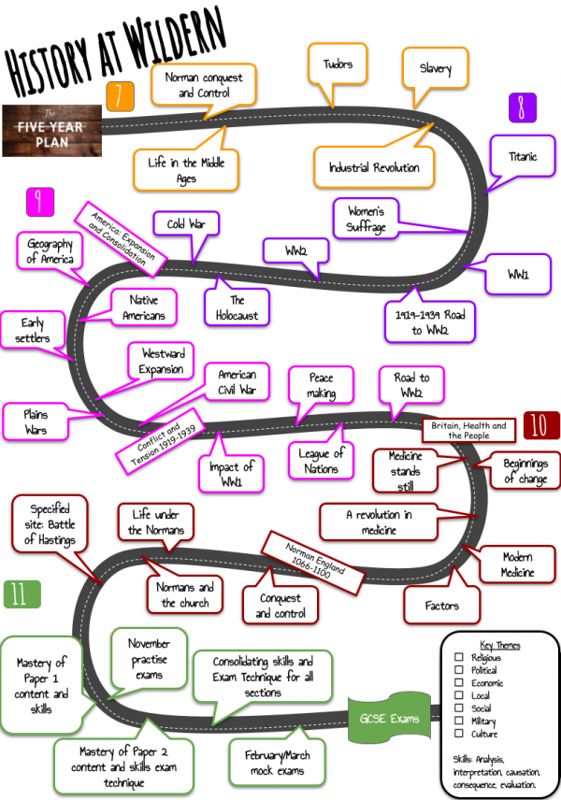
The topics covered in KS4 allow students to focus on change over time and the importance of the factors which cause them such as War and Individuals and clashes between cultures. Whether it be a whole span of history or an in-depth study students will realise that change is ongoing and this will prepare them for the world in which they live. The syllabus followed at KS4 is frequently re-evaluated to ensure the skills covered are relevant to students today. As such we are confident that by the end of KS4 students are able to understand how events are interpreted and they can form valid judgements and opinions based on a variety of sources of information. We are committed to helping all learners to achieve and ensuring that no one is left behind. GCSE History is one of the most popular option choices at KS4. We are currently switching exam boards so KS4 students in years 10 and 11 will continue follow the AQA exam syllabus over three years while our current Year 9 cohort will follow the Edexcel syllabus.
Edexcel (Current year 9)
Year 9
-
Crime and Punishment in Britain c.1000 - present
-
Weimar and Nazi Germany 1918-1939
Year 10
-
Early Elizabethan England 1558-1588
-
Superpower Relations and the Cold War 1941-1991
AQA (Current Y10 and Y11)
Year 9
-
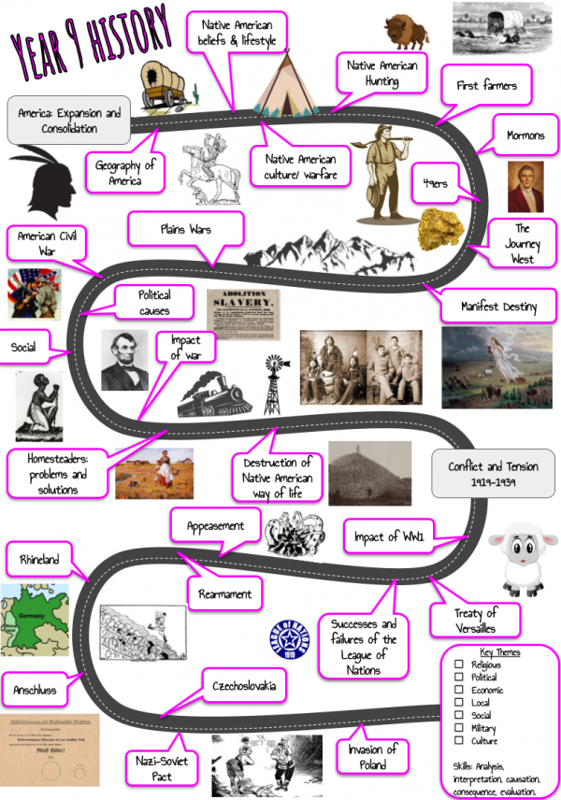
America: Expansion and Consolidation 1840 – 1895
-
Conflict and Tension: 1918 – 1939
Year 10
-
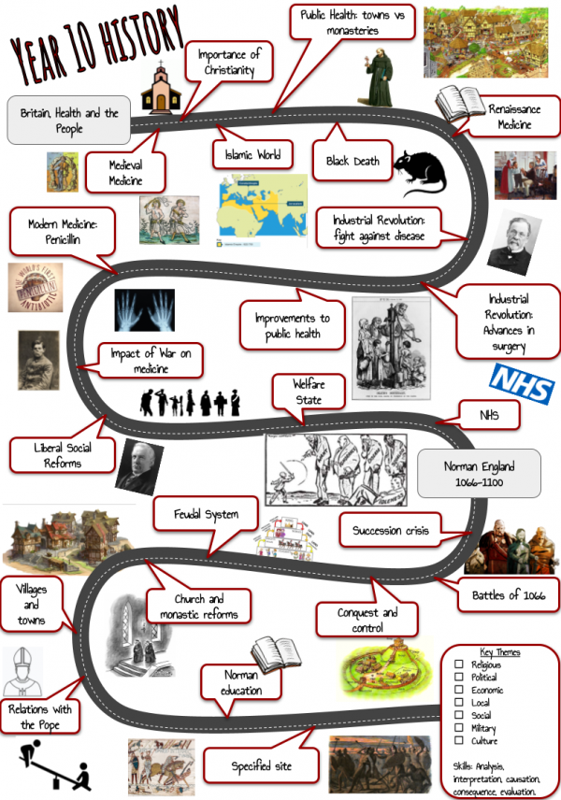
Britain: Health and the People 1000AD until the Modern Day
-
The Norman Conquest: 1066 – 1100
Year 11 for both
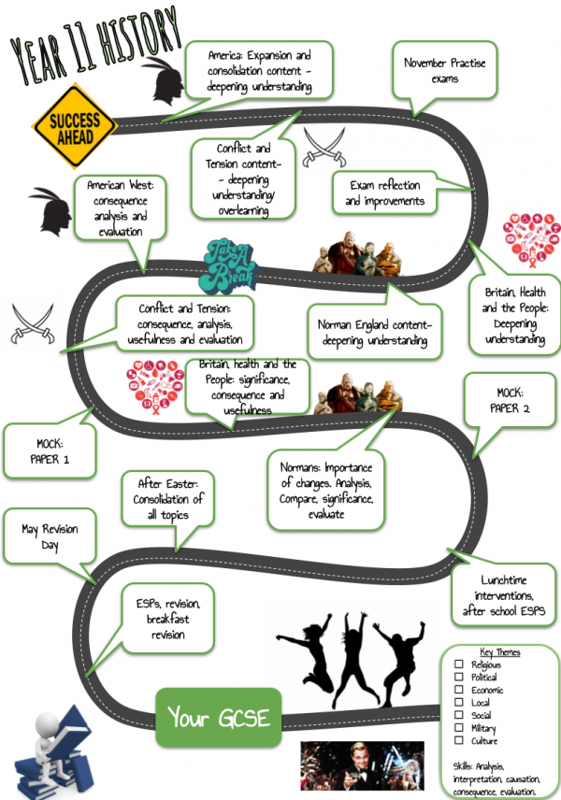
Consolidation and review of the GCSE units in order to prepare fully for the final GCSE exam which is 100% exam, sat at the end of Y11. The AQA course (Y10 and Y11) comprises of two exams worth 50% each. The Edexcel course (Y9) comprises three exams with Paper 1 and Paper 3 worth 30.95% and Paper 2 being worth 38.09%.
The history department strives to put the present into context, to cultivate students’ intellectual curiosity, and to elevate aspirations. Whilst teaching critical thinking and communication skills we impart the knowledge necessary for students' personal and professional development. Underpinning all of the topics are literacy and numeracy skills as well as cross curricular links in particular to other humanities subjects to fully place history within a cultural context.
-
Text
Facilities and rooms
The History Department has four classrooms. Each room has display boards to demonstrate the excellent work produced by the students as well as key words, concepts, literacy aids and anything else that we can fit onto our wall space to make our rooms a stimulating and rich learning environment.
Trips and Co-Curricular
As passionate Historians, we are committed to enabling students to visit key historical sites to enrich their understanding of the history curriculum and the world in which they live. As such, we run a variety of trips which vary from year to year. These trips include day trips to places such as Arundel Castle and a walking tour of Whitechapel and KS4 residential trips to the WW1 Battlefields in Belgium and France and a newly planned trip to Berlin.