
Science
Text
Nurturing curious, critical thinkers with a lifelong passion to understand human and animal behaviours and how the world works.
Philosophy
The Science Department aims to ignite curiosity, wonder, and a lifelong appreciation for learning across Science, Psychology, and Animal Care. As a team, we are deeply committed to cultivating the next generation of critical thinkers by immersing them in "real" science. By weaving topical, real-world connections into our curriculum, we enthusiastically equip students with the practical skills and core knowledge they need to thrive beyond school—whether they are pursuing science-related careers or simply navigating the analytical choices of everyday life.
Science Curriculum design
At the heart of our Science department is a passionate team dedicated to delivering motivating and inspiring lessons that blend deep scientific knowledge with practical, real-world skills. Through a wide variety of interactive learning experiences, we encourage students to actively study, practice, and apply science with confidence. To foster genuine student ownership of progress, our curriculum embeds continuous reflection directly into each topic, allowing pupils frequent opportunities to review and elevate their work. Teachers provide regular individual and whole-class verbal feedback on the spot to address and clear up misconceptions immediately, which is further supported by termly strategic assessment points that allow staff to tailor future lessons precisely to their classes' evolving strengths and weaknesses.
The curriculum is brought to life across our exceptional facilities, which feature a suite of 15 fully equipped laboratories supported by a dedicated team of technicians who collaborate with teachers to design exciting, memorable live demonstrations and practicals. We firmly believe in equipping students for the future workplace by regularly integrating ICT and Chromebook access across both Key Stage 3 and Key Stage 4 lessons to build vital, transferable digital skills. The classroom experience is further reinforced beyond the school gates through structured weekly self-study tasks, including Sparx Science and targeted exam question practice for Year 10 and 11 students. To ensure support is available whenever it is needed, additional resources, extension materials, and revision guides are continuously updated and accessible 24/7 via Google Classroom and the Science Website.
Expanders
-
KS3
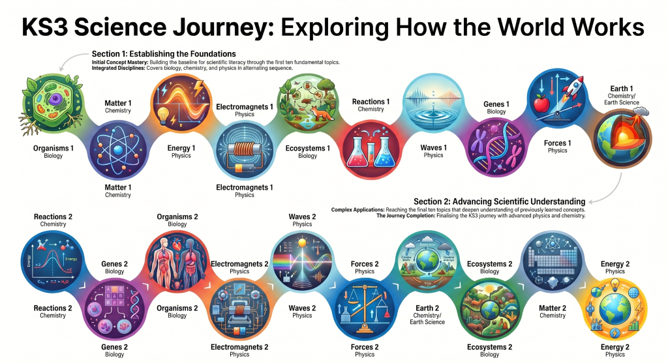
Our KS3 curriculum is designed to foster a lasting enthusiasm for science whilst building a strong foundation of scientific knowledge to facilitate student’s future studies. Year 7 begins with a series of introductory lessons specifically designed to revisit some concepts covered at Primary School. As well as completing a series of lessons to prepare them for working in a laboratory.
After this short transition period, students study key topics across Biology, Chemistry and Physics with key ideas from year 7 being built upon in year 8. The department believes that the skills and knowledge students learn and develop at Key Stage 3 will help them across the curriculum and are essential as they progress into Key Stage 4 and beyond.
-
KS4
In Year 9 students further develop their Scientific knowledge, skills and curiosity as they complete lessons to prepare for either AQA Combined Science (Trilogy) or AQA Separate Science courses which they are selected for at the end of Year 9. In Combined Science students will study all three disciplines of Biology, Chemistry and Physics and receive two GCSEs at the end of year 11. For the Separate Science GCSEs, students will study the same content as the combined GCSE but will complete additional content and practicals which will result in three GCSEs at the end of year 11. The two courses are taught through a combination of practical and content-based lessons.
The topics are split across six exam papers:
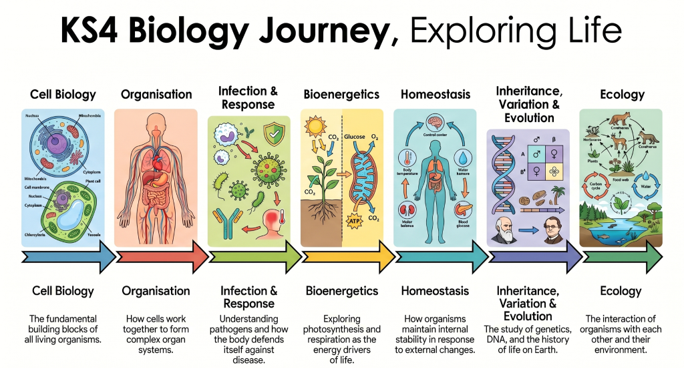
Biology Paper 1
B1: Cell biology, B2: Organisation, B3: Infection and response, B4: Bioenergetics
Biology Paper 2
B5: Homeostasis and response; B6: Inheritance, variation and evolution; B7: Ecology
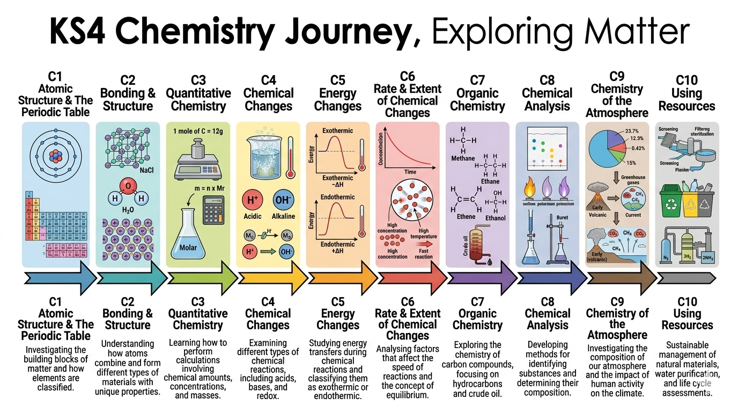
Chemistry Paper 1
C1: Atomic structure and the periodic table; C2: Bonding, structure and the properties of matter; C3: Quantitative Chemistry; C4: Chemical Changes; C5: Energy Changes
Chemistry Paper 2
C6: The rate and extent of chemical change, C7: Organic Chemistry, C8: Chemical analysis, C9: Chemistry of the atmosphere, C10:Using resources
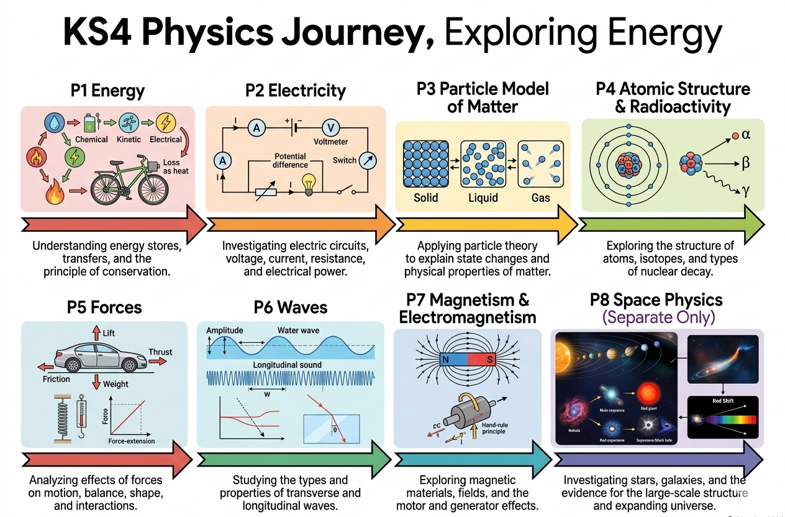
Physics Paper 1
P1: Energy, P2: Electricity, P3: Particle model of matter, P4: Atomic structure
Physics Paper 2
P5: Forces, P6: Waves, P7: Magnetism and Electromagnetism, P8: Space Physics (Separate Science only)
Text
Co-Curricular Opportunities
The science curriculum is supported by a variety of trips and after school clubs that serve to further pique student’s curiosity. These opportunities have included LifeLab, Legoland Windsor, University Hospital Southampton, Winchester Science Centre, Marwell Zoo, GCSE Science Live, Kew Gardens and many more.
STEM Club (Monday 3 pm – 4 pm)
Each week students take part in fun competitions and activities spanning across science, technology, engineering and maths.
Survival Club (Tuesday 3 pm – 4 pm)
Focusing on outdoor skills students spend an hour after school tackling various projects across the school site.