
MFL
Text
Philosophy
At Wildern School we are committed to developing strong, lifelong linguistic skills and to encourage students to become curious and interested in the world. We want all our students to feel successful in, and proud of their language skills and begin a lifelong learning journey that can open doors and take them around the world.
In the Modern Foreign Languages department at Wildern School, we aim to ensure that all language learners develop the skills and confidence to consider themselves as ‘World Citizens’ who belong in a multicultural, mutually respectful world. We aim to support students to understand other countries and cultures so that they can be more open and adaptable to new experiences; ensuring that each topic contains an element of cultural reference to not only the target language country, but the wider Francophone, Hispanic or Germanic spheres.
Ultimately, we want our students to have a love of languages, and aim to achieve this by nurturing a linguistic curiosity and an intrinsic motivation to explore, respect and communicate with other cultures and people.
Learning a language at Wildern School
The MFL Department is a dynamic, passionate, and enthusiastic department; a collaborative and creative approach to teaching and learning is embedded within daily practice and future planning. The department aims to make learning languages enjoyable and meaningful, providing students with many opportunities for both collaboration and independent work in each lesson.
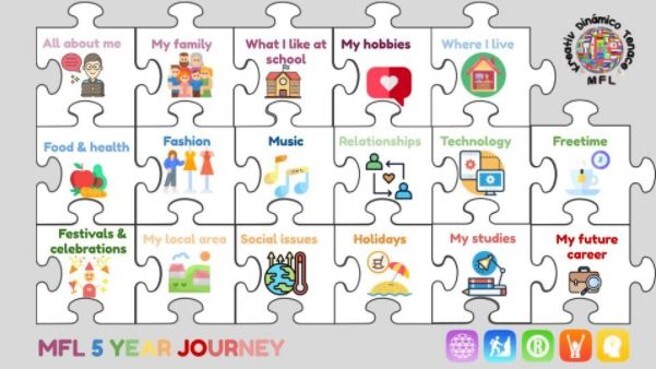
Our curriculum in French, German and Spanish is designed to ensure that all our students can make excellent progress, regardless of their prior language learning. Topics cover a range of life situations and thoroughly prepare students for the GCSE course and life beyond Wildern.
MFL Curriculum Design
Curriculum maps are designed to ensure that all four skills (Listening, Reading, Speaking and Writing) are practised regularly and key skills are built into students’ learning journeys and are regularly revisited. Students start building sentences and speaking the language straight away. Grammar is the foundation for building language skills. Learning grammar enables students to understand how language fits together and speak and write more accurately, confidently and fluently. All this is built upon students' grammatical knowledge from English lessons. Consequently, grammar skills are taught explicitly through every unit of work, and regularly revisited; emphasis is on equipping students with the linguistic skills to unpick and decode unfamiliar language.
The MFL department has high expectations for all our students and all students are supported to be the best language learner they can be. We use a range of strategies such as role-plays and sentence builder work to ensure that every lesson counts. Learning in the classroom is enhanced through self-study, which are set every week, and consist of vocabulary learning, reading and listening tasks, exam practice, and quizzes.
Students need to be resilient language learners. Within the MFL classroom, we consistently emphasise that it is ok to make mistakes. We believe where students learn is in deciding how they move on from these errors. This open environment allows students to grow in confidence and not feel intimidated in speaking out in front of the class. Opportunities for reflection are built in at regular intervals, and the curriculum is designed to build students’ independence.
With skilled native and non-native linguists in the department, we endeavour to challenge our students by using a high ratio of target language. It is one of our department aims to expose students to authentic language use in real and practical situations through the classroom teacher, the use of videos and by inviting guests into the classroom to emphasise the value of language as a communication tool. Using the target language ensures that students are hearing authentic language each time they are in the MFL classroom and by immersing them in the target language we aim to help them use it more independently and this will lead to increased confidence and wider vocabulary.
MFL at Wildern equates to a second to none introduction to lifelong language learning. Echoing the Wildern ethos and in the ever-changing face of the MFL learning landscape, we broaden our student’s horizon to breed tolerance, empathy, adaptability and consideration for others within our local and wider communities.
Expanders
-
The Wildern MFL team
The MFL department consists of 4 teachers who are able to each teach a variety of languages; French, Spanish and German, bringing languages alive for all students. All of our team are accomplished language learners and know what is needed to be successful in MFL. They all have a good story about the challenges of putting languages into practice. Why not ask next time you see them? Teachers are more than happy to answer any questions that you may have about languages at Wildern. Get in touch via wildern@wildern.org.
-
The KS3 Curriculum - starting off right...
Students at KS3 can either continue with the language that they learned at primary school (French, German or Spanish), or elect to switch to another language from scratch. At KS3 the Wildern School MFL department aims to ensure that all students:
-
Deepen their interest in the world around them by developing a knowledge of cultures and languages different to their own.
-
Feel successful in their language learning and are confident in their lessons.
-
Know what they need to improve and where their learning fits into their learning journey.
-
Are supported in their learning so that they can be the best possible linguist.
-
Understand and respond to spoken and written language from a variety of authentic sources
-
Speak with increasing confidence, fluency and spontaneity, finding ways of communicating what they want to say, including through discussion and asking questions, and continually improving the accuracy of their pronunciation and intonation
-
Can write at varying length, for different purposes and audiences, using the variety of grammatical structures that they have learnt
-
Discover and develop an appreciation of a range of writing in the language studied.
-
Understand the role of languages in their careers, later lives and wider life.
At the heart of a KS3 MFL lesson is multiple opportunities for students to learn new language and practice, building their confidence and growing their knowledge. We use sentence builders to introduce new language, giving the students the opportunity to put their vocabulary into practice immediately, knowing that they can get their message across and are supported in doing so.
-
-
Aims and Outcomes at KS3
By the end of Year 8, we expect our students to have a well-rounded level of language. Students are able to speak in the past, present and future about a range of familiar topics. They can give justified opinions and respond to questions confidently. They will have developed a range of vocabulary, beyond just their immediate needs and interests and learnt about diverse and unfamiliar customs in the French, German and Spanish speaking worlds.
In lessons, students listen to a variety of spoken language and read texts of varying length and complexity. They develop skills to deal with unknown vocabulary and become confident, fluent readers. In writing, students use a range of structures and language and adapt what they have heard and read to their own needs. Translation skills are central and students become confident in moving between languages.
-
Assessment at KS3
At KS3, students are assessed regularly, both formally and informally. There are vocabulary checks to monitor students’ vocabulary power - reflect and review lessons at regular intervals and a formal assessment prior to each WAD collection. Students are assessed on their listening, reading and writing/translation skills and are given a Wildern Step mark for each that demonstrates their progress. In class, there are quizzes, activities and recall tasks that allow students to demonstrate all the language they have learnt and to help them feel proud of their progress, lesson by lesson.
-
Self-study at KS3
In years 7 and 8, students are set weekly self-study to prepare them for their lessons and consolidate their learning. Self-study is vital in building students’ vocabulary and practising new language so that they can master their skills. In the Autumn Term of year 7, students take part in the Year 7 Vocabulary Challenge, their first house competition, and get to grips with learning to recall, spell and use new words. After Christmas and for the rest of KS3, students self-study alternates between learning new vocabulary and putting their language into practice with exercises to really embed the structures they are learning.
Here at Wildern we use the website Memrise to support student learning and give them a rewarding and interactive tool to really master vocabulary and structures.
-
The KS4 Curriculum - building independence
Students at KS4 choose a designated MFL Pathway in year 8 and continue with the language that they are learning at KS3. For our most dedicated and ambitious students, there is the option to begin a second foreign language from scratch, alongside advanced learners in year 9. Once they begin the 3 year Pearson Edexcel GCSE course, they develop their ability and ambition to communicate with native speakers in speech and writing. GCSE MFL learning also broadens students’ horizons and encourages them to step beyond familiar cultural boundaries and develop new ways of seeing the world; becoming a compassionate and resilient Global Citizen.
-
Subject aims and learning outcomes
The Pearson Edexcel course across all MFL languages taught at Wildern incorporates the latest GCSE specifications and enables students to:
-
develop their ability to communicate confidently and coherently with native speakers in speech and writing, conveying what they want to say with increasing accuracy
-
express and develop thoughts and ideas spontaneously and fluently
-
listen to and understand clearly articulated, standard speech at near normal speed
-
deepen their knowledge about how language works and enrich their vocabulary in order for them to increase their independent use and understanding of extended language in a wide range of contexts
-
acquire new knowledge, skills and ways of thinking through the ability to understand and respond to a rich range of authentic spoken and written material, adapted and abridged, as appropriate, including literary texts
-
develop awareness and understanding of the culture and identity of the countries and communities where the language is spoken
-
develop language learning skills both for immediate use and to prepare them for further language study and use in school, higher education or in employment
-
develop language strategies, including repair strategies
-
-
Context and purposes
The MFL GCSE requires students to understand and use the language across a variety of real-world contexts that match their age, interests, and maturity. To achieve this, the curriculum is structured around six engaging themes, taught progressively across Year 9, Year 10, and Year 11. The themes are as follow:
-
Theme 1: My Personal World – Exploring relationships with family and friends, peer groups, and daily life
-
Theme 2: Lifestyle and Wellbeing – Learning about healthy living, physical well-being, food, and sport
-
Theme 3: My Neighbourhood – Discovering the local town, region, and discussing environmental or social issue
-
Theme 4: Media and Technology – Navigating social media, gaming, film, TV, and modern digital life
-
Theme 5: Studying and My Future – Discussing school life, future education choices, career ambitions, and employment
-
Theme 6: Travel and Tourism – Exploring holidays, travel experiences, and interacting confidently as a tourist.
Within these themes students are expected to:
-
use language for a variety of purposes and with a variety of different audiences, including for personal, academic and employment-related use
-
make use of appropriate social conventions, including informal and formal address and register, as relevant to the task and language studied
-
understand different types of spoken language, including recorded input from one or more speakers in public and social settings and recorded material from authentic sources and the media
-
understand different types of written language, including relevant personal communication, public information, factual and literary texts
-
-
Grammar requirements at GCSE
GCSE MFL students will be expected to develop and use their knowledge and understanding of grammar progressively throughout their course. By the end of year 11 students will be able to:
-
Use verbs in the past, present and future
-
Use modal verbs to say what they want, must and can do
-
Give their opinion in a variety of ways, always explaining why
-
Link their sentences together with a range of conjunctions
-
Use a range of complex, higher level structures, such as the passive, impersonal verbs and the conditional
-
-
The GCSE languages exam
The final exam requirements for GCSE are set out in two tiers: foundation and higher and these apply to four exams (equally weighted 25% of the final GCSE grade); Listening, Reading, Writing and Speaking. The speaking exam takes place around Easter of Year 11 and modules 3 activities and lasts around 10 minutes.
More detailed information about the exam at the end of year 11 is available on the Pearson Edexcel website.
-
Self-study at KS4
At KS4 students have weekly self-study to prepare them for GCSE exams, widen their vocabulary and embed the learning that they do in class. This is achieved through a combination of vocabulary learning and independent practice tasks. Students should be regularly practicing their vocabulary on Memrise or through the interactive online textbook.
-
Assessment at KS4
At KS4, assessment mirrors the expectations of the Pearson Edexcel GCSE with adaptation to support students along the way. In year 9 students are introduced to the format of the exams and at the end of year 9 complete a full foundation tier (grades 5-1) paper in listening, reading and writing as well as a shortened version of the speaking test.. In year 10, this continues and in the year 10 practice exams, students complete a full exam in all 4 skills at either foundation (5-1) or higher (9-4) depending on progress. In year 11, students have another full set of practice exams and weekly practice papers to support final exam preparation.
-
Enrichment activities in MFL
The MFL team is dedicated to providing a rich variety of extracurricular opportunities designed to enthuse and motivate young linguists. Backed by a proud tradition of international engagement—including Languages Exchange, cultural trips to France, Spain and Germany, cultural clubs, and specialised KS4 clinics—we consistently expose students to a vibrant culture where languages are alive, relevant, and accessible to all.
The MFL team actively seeks to hold whole school activities to raise the MFL profile- highlighting the importance of language learning in our diverse world; celebrating the European Day of Languages through dance, food tasting, al fresco dining and interactive map discovery and challenge. The Wildern MFL team aims to work in collaboration with other departments in the school to ensure languages are not seen as an isolated subject just taught within the confines of the MFL classroom, but a key part of their whole curriculum.